
Exploring Algebraic Identities
Ganita Manjari Part 1 · Chapter 4 · NCERT Solutions
Welcome to Encyclohub's complete NCERT solutions for Class 9 Maths – Chapter 4: Exploring Algebraic Identities (Ganita Manjari Part 1).
All questions and solutions are presented clearly so you can understand every concept step by step. These solutions are useful for homework, revision and exam preparation.
Study Tip:
Before solving each question, try to identify which standard identity applies — this makes expansion and factorisation much faster.
Exercise Set 4.1
Using the identity (a + b)2 = a2 + 2ab + b2, expand the following:
(i) (7x + 4y)2
(ii) (75x + 32y)2
(iii) (2.5p + 1.5q)2
(iv) (34s + 8t)2
(v) (x + 12y)2
(vi) (1x + 1y)2
(i) (7x + 4y)2
Using (a + b)2 = a2 + 2ab + b2
= (7x)2 + 2(7x)(4y) + (4y)2
= 49x2 + 56x + 16y2
(ii) (75x + 32y)2
Using (a + b)2 = a2 + 2ab + b2
= (75x)2 + 2(75x)(32y) + (32y)2
= 4925x2 + 4210xy + 94y2
= 4925x2 + 215xy + 94y2
(iii) (2.5p + 1.5q)2
Using (a + b)2 = a2 + 2ab + b2
= (2.5p)2 + 2(2.5p)(1.5q) + (1.5q)2
= 6.25p2 + 7.5pq + 2.25q2
(iv) (34s + 8t)2
Using (a + b)2 = a2 + 2ab + b2
= (34s)2 + 2(34s)(8t) + (8t)2
= 916s2 + 484st + 64t2
= 916s2 + 12st + 64t2
(v) (x + 12y)2
Using (a + b)2 = a2 + 2ab + b2
= (x)2 + 2(x)(12y) + (12y)2
= x2 + xy + 14y2
(vi) (1x + 1y)2
Using (a + b)2 = a2 + 2ab + b2
= (1x)2 + 2(1x)(1y) + (1y)2
= 1x2 + 2xy + 1y2
Using the same identity, find the values of the following:
(i) (64)2 (ii) (105)2 (iii) (205)2
(i) (64)2
= (60 + 4)2
Using (a + b)2 = a2 + 2ab + b2
= (60)2 + 2(60)(4) + (4)2
= 3600 + 480 + 16
= 4096
(ii) (105)2
= (100 + 5)2
Using (a + b)2 = a2 + 2ab + b2
= (100)2 + 2(100)(5) + (5)2
= 10000 + 1000 + 25
= 11025
(iii) (205)2
= (200 + 5)2
Using the identity (a + b)2 = a2 + 2ab + b2
= (200)2 + 2(200)(5) + (5)2
= 40000 + 2000 + 25
= 42025
Exercise Set 4.2
Factor completely:
(i) 9x2 + 24xy + 16y2
(ii) 4s2 + 20st + 25t2
(iii) 49x2 + 28xy + 4y2
(iv) 64p2 + 323pq + 49q2
(v) 3a2 + 4ab + 43b2
(vi) 95s2 + 6sv + 5v2
(Hint: 2 was taken out as a common factor in Example 7. Is it possible to do something similar in Exercises (v) and (vi) above?)
(i) 9x2 + 24xy + 16y2
= (3x)2 + 2(3x)(4y) + (4y)2
Using a2 + 2ab + b2 = (a + b)2
= (3x + 4y)2
Therefore, 9x2 + 24xy + 16y2 = (3x + 4y)2
(ii) 4s2 + 20st + 25t2
= (2s)2 + 2(2s)(5t) + (5t)2
Using a2 + 2ab + b2 = (a + b)2
= (2s + 5t)2
Therefore, 4s2 + 20st + 25t2 = (2s + 5t)2
(iii) 49x2 + 28xy + 4y2
= (7x)2 + 2(7x)(2y) + (2y)2
Using a2 + 2ab + b2 = (a + b)2
= (7x + 2y)2
Therefore, 49x2 + 28xy + 4y2 = (7x + 2y)2
(iv) 64p2 + 323pq + 49q2
= (8p)2 + 2(8p)(23q) + (23q)2
Using a2 + 2ab + b2 = (a + b)2
= (8p + 23q)2
Therefore, 64p2 + 323pq + 49q2 = (8p + 23q)2
(v) 3a2 + 4ab + 43b2
Taking out 3 as a factor,
= 3(a2 + 43ab + 49b2)
= 3[(a)2 + 2(a)(23b) + (23b)2]
Using a2 + 2ab + b2 = (a + b)2
= 3(a + 23b)2
Therefore, 3a2 + 4ab + 43b2 = 3(a + 23b)2
(vi) 95s2 + 6sv + 5v2
Taking out 95 as a factor,
= 95(s2 + 103sv + 259v2)
= 95[(s)2 + 2(s)(53v) + (53v)2]
Using a2 + 2ab + b2 = (a + b)2
= 95(s + 53v)2
Therefore, 95s2 + 6sv + 5v2 = 95(s + 53v)2
Find the values of the following using the identity (a – b)2 = a2 – 2ab + b2.
(i) (79)2
(ii) (193)2
(iii) (299)2
(i) (79)2
= (80 – 1)2
Using (a – b)2 = a2 – 2ab + b2
= (80)2 – 2(80)(1) + (1)2
= 6400 – 160 + 1
= 6401 – 160
= 6241
(ii) (193)2
= (200 – 7)2
Using (a – b)2 = a2 – 2ab + b2
= (200)2 – 2(200)(7) + (7)2
= 40000 – 2800 + 49
= 40049 – 2800
= 37249
(iii) (299)2
= (300 – 1)2
Using (a – b)2 = a2 – 2ab + b2
= (300)2 – 2(300)(1) + (1)2
= 90000 – 600 + 1
= 90001 – 600
= 89401
Exercise Set 4.3
Find the following squares using one of the above identities. Determine which of these identities will make these calculations easier.
(i) 1172 (ii) 782 (iii) 1982 (iv) 2142 (v) 11042 (vi) 11202
(i) 1172
= (100 + 17)2
Using (a + b)2 = a2 + 2ab + b2
= (100)2 + 2(100)(17) + (17)2
= 10000 + 3400 + 289
= 13689
(ii) 782
= (70 + 8)2
Using (a + b)2 = a2 + 2ab + b2
= (70)2 + 2(70)(8) + (8)2
= 4900 + 1120 + 64
= 6084
(iii) 1982
= (200 – 2)2
Using (a – b)2 = a2 – 2ab + b2
= (200)2 – 2(200)(2) + (2)2
= 40000 – 800 + 4
= 40004 – 800
= 39204
(iv) 2142
= (200 + 14)2
Using (a + b)2 = a2 + 2ab + b2
= (200)2 + 2(200)(14) + (14)2
= 40000 + 5600 + 196
= 45796
(v) 11042
= (1000 + 100 + 4)2
Using (a + b + c)2 = a2 + b2 + c2 + 2ab + 2bc + 2ca
= (1000)2 + (100)2 + (4)2 + 2(1000)(100) + 2(100)(4) + 2(4)(1000)
= 1000000 + 10000 + 16 + 200000 + 800 + 8000
= 1218816
(vi) 11202
= (1000 + 100 + 20)2
Using (a + b + c)2 = a2 + b2 + c2 + 2ab + 2bc + 2ca
= (1000)2 + (100)2 + (20)2 + 2(1000)(100) + 2(100)(20) + 2(20)(1000)
= 1000000 + 10000 + 400 + 200000 + 4000 + 40000
= 1254400
Factor using suitable identities:
(i) 16y2 – 24y + 9
(ii) 94s2 + 6st + 4t2
(iii) m29 + mk3 + k24 + 3nk + 2mn + 9n2
(iv) p216 – 2 + 16p2
(v) 9a2 + 4b2 + c2 − 12ab + 6ac − 4bc
(i) 16y2 – 24y + 9
= (4y)2 – 2(4y)(3) + (3)2
Using the identity a2 – 2ab + b2 = (a – b)2
= (4y – 3)2
Therefore, 16y2 – 24y + 9 = (4y – 3)2
(ii) 94s2 + 6st + 4t2
= (32s)2 + 2(32s)(2t) + (2t)2
Using a2 + 2ab + b2 = (a + b)2
= (32s + 2t)2
Therefore, 94s2 + 6st + 4t2 = (32s + 2t)2
(iii) m29 + mk3 + k24 + 3nk + 2mn + 9n2
= m29 + k24 + 9n2 + mk3 + 3nk + 2mn
= (m3)2 + (k2)2 + (3n)2 + 2(m3)(k2) + 2(k2)(3n) + 2(3n)(m3)
Using a2 + b2 + c2 + 2ab + 2bc + 2ca = (a + b + c)2
= (m3 + k2 + 3n)2
Therefore, m29 + mk3 + k24 + 3nk + 2mn + 9n2 = (m3 + k2 + 3n)2
(iv) p216 – 2 + 16p2
= (p4)2 – 2(p4)(4p) + (4p)2
Using a2 – 2ab + b2 = (a – b)2
= (p4 – 4p)2
Therefore, p216 – 2 + 16p2 = (p4 – 4p)2
(v) 9a2 + 4b2 + c2 − 12ab + 6ac − 4bc
= (3a)2 + (–2b)2 + c2 + 2(3a)(–2b) + 2(3a)(c) + 2(–2b)(c)
Using a2 + b2 + c2 + 2ab + 2bc + 2ca = (a + b + c)2
= [3a + (–2b) + c]2
= (3a – 2b + c)2
Therefore, 9a2 + 4b2 + c2 − 12ab + 6ac − 4bc = (3a – 2b + c)2
Expand the following using the identity (a + b + c)2 = a2 + b2 + c2 + 2ab + 2bc + 2ca:
(i) (p + 3q + 7r)2
(ii) (3x – 2y + 4z)2
(i) (p + 3q + 7r)2
Using (a + b + c)2 = a2 + b2 + c2 + 2ab + 2bc + 2ca
= (p)2 + (3q)2 + (7r)2 + 2(p)(3q) + 2(3q)(7r) + 2(7r)(p)
= p2 + 9q2 + 49r2 + 6pq + 42qr + 14rp.
(ii) (3x – 2y + 4z)2
= [3x + (–2y) + 4z]2
Using (a + b + c)2 = a2 + b2 + c2 + 2ab + 2bc + 2ca
= (3x)2 + (–2y)2 + (4z)2 + 2(3x)(–2y) + 2(–2y)(4z) + 2(4z)(3x)
= 9x2 + 4y2 + 16z2 – 12xy – 16yz + 24xz.
Is this an identity?
(a + b − c)2 + (a − b + c)2 + (a − b − c)2 = 2a + 2b + 2c.
LHS = (a + b − c)2 + (a − b + c)2 + (a − b − c)2
Using (x + y + z)2 = x2 + y2 + z2 + 2xy + 2yz + 2zx
= [a2 + b2 + (–c)2 + 2ab + 2a(–c) + 2b(–c)] + [a2 + (–b)2 + c2 + 2a(–b) + 2(–b)c + 2ac] + [a2 + (–b)2 + (–c)2 + 2a(–b) + 2(–b)(–c) + 2a(–c)]
= (a2 + b2 + c2 + 2ab − 2bc − 2ac) + (a2 + b2 + c2 – 2ab − 2bc + 2ac) + (a2 + b2 + c2 – 2ab + 2bc – 2ac)
= a2 + a2 + a2 + b2 + b2 + b2 + c2 + c2 + c2 + 2ab – 2ab – 2ab – 2ac + 2ac – 2ac – 2bc – 2bc + 2bc
= 3a2 + 3b2 + 3c2 – 2ab – 2bc – 2ac.
RHS = 2a + 2b + 2c.
Since LHS ≠ RHS
Hence, the given equation is not an identity.
Exercise Set 4.4
Fill in the blanks to complete the following identities:
(i) s2 – 11s + 24 = (________) (________)
(ii) (________) (x + 1) = (3x2 – 4x – 7)
(iii) 10x2 – 11x – 6 = (2x – ___) (___ + 2)
(iv) 6x2 + 7x + 2 = (____________) (___________)
(i) s2 – 11s + 24 = (________) (________)
s2 – 11s + 24
= s2 – 3s – 8s + 24
= s(s − 3) − 8(s − 3)
= (s − 3)(s − 8)
∴ s2 – 11s + 24 = (s − 3)(s − 8)
(ii) (________) (x + 1) = (3x2 – 4x – 7)
3x2 – 4x – 7
= 3x2 − 7x + 3x − 7
= x(3x − 7) + 1(3x − 7)
= (3x − 7)(x + 1)
∴ (3x − 7) (x + 1) = (3x2 – 4x – 7)
(iii) 10x2 – 11x – 6 = (2x – ___) (___ + 2)
10x2 – 11x – 6
= 10x2 − 15x + 4x – 6
= 5x(2x − 3) + 2(2x − 3)
= (2x − 3)(5x + 2)
∴ 10x2 – 11x – 6 = (2x − 3)(5x + 2)
(iv) 6x2 + 7x + 2 = (____________) (___________)
6x2 + 7x + 2
= 6x2 + 3x + 4x + 2
= 3x(2x + 1) + 2(2x + 1)
= (3x + 2)(2x + 1)
∴ 6x2 + 7x + 2 = (3x + 2)(2x + 1)
Select and use the identity that will help you to find the following products without multiplying directly:
(i) (41)2 (ii) (27)2 (iii) (23 × 17) (iv) (135)2 (v) (97)2 (vi) (18 × 29) (vii) (34 × 43) (viii) (205)2
(i) (41)2
= (40 + 1)2
Using (a + b)2 = a2 + 2ab + b2
= (40)2 + 2(40)(1) + (1)2
= 1600 + 80 + 1
= 1681.
(ii) (27)2
= (30 – 3)2
Using (a – b)2 = a2 – 2ab + b2
= (30)2 – 2(30)(3) + (3)2
= 900 – 180 + 9
= 909 – 180
= 729.
(iii) (23 × 17)
= (20 + 3)(20 – 3)
Using (a + b)(a – b) = a2 – b2
= (20)2 – (3)2
= 400 – 9
= 391.
(iv) (135)2
= (100 + 30 + 5)2
Using (a + b + c)2 = a2 + b2 + c2 + 2ab + 2bc + 2ca
= (100)2 + (30)2 + (5)2 + 2(100)(30) + 2(30)(5) + 2(5)(100)
= 10000 + 900 + 25 + 6000 + 300 + 1000
= 18225.
(v) (97)2
= (100 – 3)2
Using (a – b)2 = a2 – 2ab + b2
= (100)2 – 2(100)(3) + (3)2
= 10000 – 600 + 9
= 10009 – 600
= 9409.
(vi) (18 × 29)
= [{23 + (–5)} × (23 + 6)]
Using the identity (x + a)(x + b) = x2 + (a + b)x + ab
= (23)2 + {(–5) + 6}(23) + (–5)(6)
= 529 + (1)(23) + (–30)
= 529 + 23 – 30
= 552 – 30
= 522.
(vii) (34 × 43)
= {38 + (–4)} × (38 + 5)
Using (x + a)(x + b) = x2 + (a + b)x + ab
= (38)2 + {(–4) + 5}(38) + (–4)(5)
= 1444 + (1)(38) + (–20)
= 1444 + 38 – 20
= 1482 – 20
= 1462
(viii) (97)2
= (100 – 3)2
Using (a – b)2 = a2 – 2ab + b2
= (100)2 – 2(100)(3) + (3)2
= 10000 – 600 + 9
= 9400 + 9
= 9409.
Factor the following:
(i) 9a2 + b2 + 4c2 – 6ab + 12ac – 4bc
(ii) 16s2 + 25t2 – 40st
(iii) r2 – r – 42
(iv) 49g2 + 14gh + h2
(v) 64u2 + 121v2 + 4w2 – 176uv – 32uw + 44vw
(i) 9a2 + b2 + 4c2 – 6ab + 12ac – 4bc
Using a2 + b2 + c2 + 2ab + 2bc + 2ca = (a + b + c)2
= (3a)2 + (–b)2 + (2c)2 + 2(3a)(–b) + 2(3a)(2c) + 2(–b)(2c)
= {3a + (–b) + 2c}2
= (3a – b + 2c)2
(ii) 16s2 + 25t2 – 40st
Using (a – b)2 = a2 – 2ab + b2
= (4s)2 + (5t)2 – 2(4s)(5t)
= (4s – 5t)2
(iii) r2 – r – 42
= r2 – 7r + 6r – 42
= r(r – 7) + 6(r – 7)
= (r – 7) (r + 6)
(iv) 49g2 + 14gh + h2
Using (a + b)2 = a2 + 2ab + b2
= (7g)2 + 2(7g)(h) + (h)2
= (7g + h)2
(v) 64u2 + 121v2 + 4w2 – 176uv – 32uw + 44vw
Using a2 + b2 + c2 + 2ab + 2bc + 2ca = (a + b + c)2
= (–8u)2 + (11v)2 + (2w)2 + 2(–8u)(11v) + 2(–8u)(2w) + 2(11v)(2w)
= (–8u + 11v + 2w)2
Exercise Set 4.5
Simplify the following rational expressions, assuming that the expressions in the denominators are not equal to zero:
(i) 3p2 − 3pq − 18q2p2 + 3pq − 10q2
(ii) n3 − 3n2m + 3nm2 − m35m2 − 10mn + 5n2
(iii) w3 − v3 + x3 + 3wvxw2 + v2 + x2 − 2wv − 2vx + 2wx
(iv) 4y2 − 20yz + 25z2(25z2 − 4y2)
(v) (x2 + x − 6)(x2 − 7x + 12)(x2 − 6x + 8)(x2 − 9)
(vi) p4 − 16p2 − 4p + 4
(i) 3p2 − 3pq − 18q2p2 + 3pq − 10q2
Factorising the numerator:
3p2 − 3pq − 18q2
= 3(p2 − pq − 6q2)
= 3[p2 – 3pq + 2pq – 6q2]
= 3[p(p – 3q) + 2q(p – 3q)]
= 3(p + 2q)(p – 3q)
Factorising the denominator:
p2 + 3pq − 10q2
= p2 + 5pq – 2pq – 10q2
= p(p + 5q) – 2q(p + 5q)
= (p + 5q)(p – 2q)
Now, since the denominator is not equal to zero.
Therefore,
3p2 − 3pq − 18q2p2 + 3pq − 10q2 = 3(p + 2q)(p – 3q)(p + 5q)(p – 2q).
(ii) n3 − 3n2m + 3nm2 − m35m2 − 10mn + 5n2
Factorising the numerator:
n3 − 3n2m + 3nm2 − m3
= (n)3 – 3(n)2(m) + 3(n)(m)2 – (m)3
Using x3 – 3x2y + 3xy2 – y3 = (x – y)3
= (n – m)3
Factorising the denominator:
5m2 − 10mn + 5n2
= 5n2 − 10mn + 5m2
= 5(n2 − 2mn + m2)
= 5[(n)2 – 2(m)(n) + (m)2]
Using a2 – 2ab + b2 = (a – b)2
= 5(n – m)2
Now, since the denominator is not equal to zero.
Therefore,
n3 − 3n2m + 3nm2 − m35m2 − 10mn + 5n2 = (n – m)35(n – m)2 = (n – m)5.
(iii) w3 − v3 + x3 + 3wvxw2 + v2 + x2 − 2wv − 2vx + 2wx
Factorising the numerator:
Using the identity x3 + y3 + z3 – 3xyz = (x + y + z)(x2 + y2 + z2 – xy – xz – yz)
w3 − v3 + x3 + 3wvx = w2 + (–v)2 + x2 – 3w(–v)x = [w + (–v) + x][(w)2 + (–v)2 + (x)2 – (w)(–v) – (w)(x) – (–v)(x)]
⇒ w3 − v3 + x3 + 3wvx = (w – v + x)(w2 + v2 + x2 + wv – wx + vx)
Factorising the denominator:
w2 + v2 + x2 − 2wv − 2vx + 2wx
= (w)2 + (–v)2 + (x)2 + 2(w)(–v) + 2(–v)(x) + 2(w)(x)
Using (a + b + c)2 = a2 + b2 + c2 + 2ab + 2bc + 2ca
= [w + (–v) + x]2
= (w – v + x)2
Now, since the denominator is not equal to zero.
Therefore,
w3 − v3 + x3 + 3wvxw2 + v2 + x2 − 2wv − 2vx + 2wx = (w – v + x)(w2 + v2 + x2 + wv – wx + vx)(w – v + x)2 = (w2 + v2 + x2 + wv – wx + vx)(w – v + x).
(iv) 4y2 − 20yz + 25z2(25z2 − 4y2)
Factorising the numerator:
4y2 − 20yz + 25z2
= (2y)2 – 2(2y)(5z) + (5z)2
Using (a – b)2 = a2 – 2ab + b2
= (2y – 5z)2
Factorising the denominator:
25z2 − 4y2
= (5z)2 – (2y)2
Using a2 – b2 = (a – b)(a + b)
= (5z – 2y)(5z + 2y)
Now, since the denominator is not equal to zero.
Therefore,
4y2 − 20yz + 25z2(25z2 − 4y2) = (2y – 5z)2(5z – 2y)(5z + 2y) = [–(5z – 2y)]2(5z – 2y)(5z + 2y) = (5z – 2y)2(5z – 2y)(5z + 2y) = (5z – 2y)(5z + 2y).
(v) (x2 + x − 6)(x2 − 7x + 12)(x2 − 6x + 8)(x2 − 9)
Factorising the numerator,
x2 – x – 6 = x2 + 3x – 2x – 6 = x(x + 3) – 2(x + 3) = (x + 3)(x – 2)
x2 – 7x + 12 = x2 – 3x – 4x + 12 = x(x – 3) – 4(x – 3) = (x – 3)(x – 4)
Factorising the denominator:
x2 – 6x + 8 = x2 – 2x – 4x + 8 = x(x – 2) – 4(x – 2) = (x – 2)(x – 4)
x2 – 9 = (x)2 – (3)2
Using a2 – b2 = (a – b)(a + b)
= (x – 3)(x + 3)
Now, since the denominator is not equal to zero.
Therefore,
(x2 + x − 6)(x2 − 7x + 12)(x2 − 6x + 8)(x2 − 9) = (x + 3)(x – 2)(x – 3)(x – 4)(x – 2)(x – 4)(x – 3)(x + 3) = 1.
(vi) p4 − 16p2 − 4p + 4
Factorising the numerator,
p4 – 16 = (p2)2 – (4)2
Using a2 – b2 = (a – b)(a + b)
= (p2 – 4)(p2 + 4)
= [(p)2 – (2)2](p2 + 4)
= (p – 2)(p + 2)(p2 + 4)
Factorising the denominator,
p2 – 4p + 4 = p2 – 2p – 2p + 4 = p(p – 2) – 2(p – 2) = (p – 2)(p – 2)
Therefore,
p4 − 16p2 − 4p + 4 = (p – 2)(p + 2)(p2 + 4)(p – 2)(p – 2) = (p + 2)(p2 + 4)(p – 2).
End of Chapter Exercise (Page 88 – 90)
Use suitable identities to find the following products:
(i) (–3x + 4)2
(ii) (2s + 7)(2s – 7)
(iii) (p2 + 12)(p2 – 12)
(iv) (2n + 7)(2n – 7)
(v) (s – 2t)(s2 + 2st + 4t2)
(vi) (12r – 4r)2
(vii) (–3m + 4k – l)2
(viii) (x – 13y)3
(ix) (72k – 23m)3
(i) (–3x + 4)2
Using (a + b)2 = a2 + 2ab + b2
= (–3x)2 + 2(–3x)(4) + (4)2
= 9x2 – 24x + 16
(ii) (2s + 7)(2s – 7)
Using (a + b)(a – b) = a2 – b2
= (2s)2 – (7)2
= 4s2 – 49
(iii) (p2 + 12)(p2 – 12)
Using (a + b)(a – b) = a2 – b2
= (p2)2 – (12)2
= p4 – 14
(iv) (2n + 7)(2n – 7)
Using (a + b)(a – b) = a2 – b2
= (2n)2 – (7)2
= 4n2 – 49
(v) (s – 2t)(s2 + 2st + 4t2)
Using (a − b)(a2 + ab + b2) = a3 − b3
= (s – 2t)[(s)2 + (s)(2t) + (2t)2]
= (s)3 – (2t)3
= s3 – 8t3
(vi) (12r – 4r)2
Using (a – b)2 = a2 – 2ab + b2
= (12r)2 – 2(12r)(4r) + (4r)2
= 14r2 – 4 + 16r2
= 16r2 + 14r2 – 4
(vii) (–3m + 4k – l)2
Using (a + b + c)2 = a2 + b2 + c2 + 2ab + 2bc + 2ca
= (–3m)2 + (4k)2 + (–l)2 + 2(–3m)(4k) + 2(4k)(–l) + 2(–l)(–3m)
= 9m2 + 16k2 + l2 – 24mk – 8kl + 6ml
(viii) (x – 13y)3
Using (a – b)3 = a3 – 3a2b + 3ab2 – b3
= (x)3 – 3(x)2(13y) + 3(x)(13y)2 – (13y)3
= x3 – 3.x2.13y + 3.x.19y2 – 127y3
= x3 – x2y + 13xy2 – 127y3
(ix) (72k – 23m)3
Using (a – b)3 = a3 – 3a2b + 3ab2 – b3
= (72k)3 – 3(72k)2(23m) + 3(72k)(23m)2 – (23m)3
= 3438k2 – 3.494k2.23m + 3.72k.49m2 – 827m3
= 3438k2 – 492k2m + 143km2 – 827m3
Find the values using suitable identities:
(i) 17 × 21 (ii) 104 × 96 (iii) 24 × 16 (iv) 1473 (v) 1993 (vi) 1273 (vii) (–107)3 (viii) (–299)3
(i) 17 × 21
Using (a – b)(a + b) = a2 – b2
= (19 – 2)(19 + 2)
= (19)2 – (2)2
= 361 – 4
= 357
(ii) 104 × 96
Using (a + b)(a – b) = a2 – b2
= (100 + 4)(100 – 4)
= (100)2 – (4)2
= 10000 – 16
= 9984
(iii) 24 × 16
Using (a + b)(a – b) = a2 – b2
= (20 + 4)(20 – 4)
= (20)2 – (4)2
= 400 – 16
= 384
(iv) 1473
Using (a – b)3 = a3 – 3a2b + 3ab2 – b3
= (150 – 3)3
= (150)3 – 3(150)2(3) + 3(150)(3)2 – (3)3
= 3375000 − 202500 + 4050 − 27
= 3176523
(v) 1993
Using (a – b)3 = a3 – 3a2b + 3ab2 – b3
= (200 – 1)3
= (200)3 – 3(200)2(1) + 3(200)(1)2 – (1)3
= 8000000 − 120000 + 600 − 1
= 7880599
(vi) 1273
Using (a + b)3 = a3 + 3a2b + 3ab2 + b3
= (100 + 27)3
= (100)3 – 3(100)2(27) + 3(100)(27)2 – (27)3
= 1000000 + 810000 + 218700 + 19683
= 2048383
(vii) (–107)3
Using (a + b)3 = a3 + 3a2b + 3ab2 + b3
= (–100 – 7)3
= (–100)3 + 3(–100)2(–7) + 3(–100)(–7)2 + (–7)3
= −1000000 − 210000 − 14700 − 343
= −1225043
(viii) (–299)3
Using (a + b)3 = a3 + 3a2b + 3ab2 + b3
= (–300 + 1)3
= (–300)3 + 3(–300)2(1) + 3(–300)(1)2 + (1)3
= −27000000 + 270000 − 900 + 1
= −26730900 + 1
= −26730899
Factor the following algebraic expressions:
(i) 4y2 + 1 + 116y2
(ii) 9m2 – 125n2
(iii) 27b3 – 164b3
(iv) x2 + 5x6 + 16
(v) 27u3 – 1125 – 27u25 + 9u25
(vi) 64y3 + 1125z3
(vii) p3 + 27q3 + r3 – 9pqr
(viii) 9m2 – 12m + 4
(ix) 9x3 – 83y3 + z33 + 6xyz
(x) 4x2 + 9y2 + 36z2 + 12xz + 36yz + 24xy
(xi) 27u3 – 1216 – 9u22 + u4
(i) 4y2 + 1 + 116y2
Using a2 + 2ab + b2 = (a + b)2
= (2y)2 + 2(2y)(14y) + (14y)2
= (2y + 14y)2
(ii) 9m2 – 125n2
Using a2 – b2 = (a – b)(a + b)
= (3m)2 – (15n)2
= (3m – 15n)(3m + 15n)
(iii) 27b3 – 164b3
Using a3 − b3 = (a − b)(a2 + ab + b2)
= (3b)3 – (14b)3
= (3b – 14b)[(3b)2 + (3b)(14b) + (14b)2]
= (3b – 14b)(9b2 + 34 + 116b2)
(iv) x2 + 5x6 + 16
= x2 + x3 + x2 + 16
= x(x + 13) + 12(x + 13)
= (x + 13)(x + 12)
(v) 27u3 – 1125 – 27u25 + 9u25
Using a3 – 3a2b + 3ab2 – b3 = (a – b)3
= (3u)3 – (15)3 – 3(3u)2(15) + 3(3u)(15)2
= (3u – 15)3
(vi) 64y3 + 1125z3
Using a3 + b3 = (a + b)(a2 – ab + b2)
= (4y)2 + (z5)3
= (4y + z5)[(4y)2 – (4y)(z5) + (z5)2]
= (4y + z5)(16y2 – 4yz5 + z225)
(vii) p3 + 27q3 + r3 – 9pqr
Using x3 + y3 + z3 – 3xyz = (x + y + z)(x2 + y2 + z2 – xy – xz – yz)
p3 + 27q3 + r3 – 9pqr = (p)3 + (3q)3 + (r)3 – 3(p)(3q)(r)
Thus, x = p, y = 3q, z = r
So, p3 + 27q3 + r3 – 9pqr = (p + 3q + r)[(p)2 + (3q)2 + (r)2 – (p)(3q) – (3q)(r) – (p)(r)]
= (p + 3q + r)(p2 + 9q2 + r2 – 3pq – pr – 3qr)
(viii) 9m2 – 12m + 4
Using a2 – 2ab + b2 = (a – b)2
= (3m)2 – 2(3m)(2) + (2)2
= (3m – 2)2
(ix) 9x3 – 83y3 + z33 + 6xyz
Taking out 13 as a factor,
= 13(27x3 – 8y3 + z3 + 18xyz)
Using a3 + b3 + c3 – 3abc = (a + b + c)(a2 + b2 + c2 – ab – bc – ca)
27x3 – 8y3 + z3 + 18xyz = (3x)3 + (–2y)3 + (z)3 – 3(3x)(–2y)(z)
Thus, a = 3x, b = (–2y) and c = z
13(27x3 – 8y3 + z3 + 18xyz) = 13[3x + (–2y) + z][(3x)2 + (–2y)2 + (z)2 – (3x)(–2y) – (–2y)(z) – (3x)(z)]
= 13(3x – 2y + z)(9x2 + 4y2 + z2 + 6xy + 2yz – 3xz)
(x) 4x2 + 9y2 + 36z2 + 12xz + 36yz + 24xy
Using a2 + b2 + c2 + 2ab + 2bc + 2ca = (a + b + c)2
= (2x)2 + (3y)2 + (6z)2 + 2(2x)(3y) + 2(3y)(6z) + 2(2x)(6z)
= (2x + 3y + 6z)2
(xi) 27u3 – 1216 – 9u22 + u4
Using a3 – 3a2b + 3ab2 – b3 = (a – b)3
= (3u)3 – (16)3 – 3(3u)2(16) + 3(3u)(16)2
= (3u – 16)3
Simplify the following:
(i) 4x2 + 4x + 14x2 − 1
(ii) 9(3a3 − 24b3)9a2 − 36b2
(iii) s3 + 125t3s2 − 2st − 35t2
Note: Assume that the denominators are not equal to 0.
(i) 4x2 + 4x + 14x2 − 1
Factorising the numerator:
4x2 + 4x + 1
Using a2 + 2ab + b2 = (a + b)2
= (2x)2 + 2(2x)(1) + (1)2
= (2x + 1)2
Factorising the denominator:
4x2 − 1
Using a2 – b2 = (a – b)(a + b)
= (2x)2 – (1)2
= (2x – 1)(2x + 1)
Since the denominator is not equal to zero.
Therefore,
4x2 + 4x + 14x2 − 1 = (2x + 1)2(2x – 1)(2x + 1) = (2x + 1)(2x – 1)
(ii) 9(3a3 − 24b3)9a2 − 36b2
= 9 × 3(a3 − 8b3)9(a2 − 4b2)
= 3(a3 − 8b3)(a2 − 4b2)
Factorising the numerator:
Using a3 − b3 = (a − b)(a2 + ab + b2)
= 3[(a)3 – (2b)3]
= 3[(a – 2b){a2 + (a)(2b) + (2b)2}]
= 3(a – 2b)(a2 + 2ab + 4b2)
Factorising the denominator:
a2 − 4b2
Using a2 – b2 = (a – b)(a + b)
= (a)2 – (2b)2
= (a – 2b)(a + 2b)
Since the denominator is not equal to zero.
Therefore,
3(a3 − 8b3)(a2 − 4b2) = 3(a – 2b)(a2 + 2ab + 4b2)(a – 2b)(a + 2b) = 3(a2 + 2ab + 4b2)(a + 2b)
(iii) s3 + 125t3s2 − 2st − 35t2
Factorising the numerator:
s3 + 125t3
Using a3 + b3 = (a + b)(a2 – ab + b2)
= (s)3 + (5t)3
= (s + 5t)[(s)2 – (s)(5t) + (5t)2]
= (s + 5t)(s2 – 5st + 25t2)
Factorising the denominator:
s2 − 2st − 35t2
= s2 – 7st + 5st – 35t2
= s(s – 7t) + 5t(s – 7t)
= (s – 7t)(s + 5t)
Since the denominator is not equal to zero.
Therefore,
s3 + 125t3s2 − 2st − 35t2 = (s + 5t)(s2 – 5st + 25t2)(s – 7t)(s + 5t) = (s2 – 5st + 25t2)(s – 7t)
Find possible expressions for the length and breadth of each of the following rectangles whose areas are given by the following expressions in square units.
(i) 25a2 – 30ab + 9b2
(ii) 36s2 – 49t2
(i) Area = 25a2 – 30ab + 9b2
Using a2 − 2ab + b2 = (a − b)2
25a2 − 30ab + 9b2 = (5a)2 − 2(5a)(3b) + (3b)2
= (5a − 3b)2
Hence, possible expressions for the length and breadth are (5a − 3b) and (5a − 3b).
(ii) Area = 36s2 – 49t2
Using a2 – b2 = (a – b)(a + b)
36s2 – 49t2 = (6s)2 – (7t)2
= (6s – 7t)(6s + 7t)
Hence, possible expressions for the length and breadth are (6s − 7t) and (6s + 7t).
Find possible expressions for the length, breadth, and heights of each of the following cuboids whose volumes are given by the following expressions in cubic units.
(i) 6a2 – 24b2
(ii) 3ps2 – 15ps + 12p
(i) Volume = 6a2 – 24b2
= 6(a2 – 4b2)
Using a2 – b2 = (a – b)(a + b)
= 6[(a)2 – (2b)2]
= 6(a – 2b)(a + 2b)
Therefore, 6a2 – 24b2 = 6(a – 2b)(a + 2b)
Hence, possible expressions for the length, breadth, and height are 6, (a − 2b), (a + 2b).
(ii) Volume = 3ps2 – 15ps + 12p
= 3p(s2 – 5s + 4)
= 3p[s2 – 4s – s + 4]
= 3p[s(s – 4) −1(s – 4)]
= 3p(s – 4)(s – 1)
Therefore, 3ps2 – 15ps + 12p = 3p(s – 4)(s – 1)
Hence, possible expressions for the length, breadth, and height are 3p, (s – 4), (s – 1).
The village playground is shaped as a square of side 40 metres. A path of width s metres is created around the playground for people to walk. Find an expression for the area of the path in terms of s.
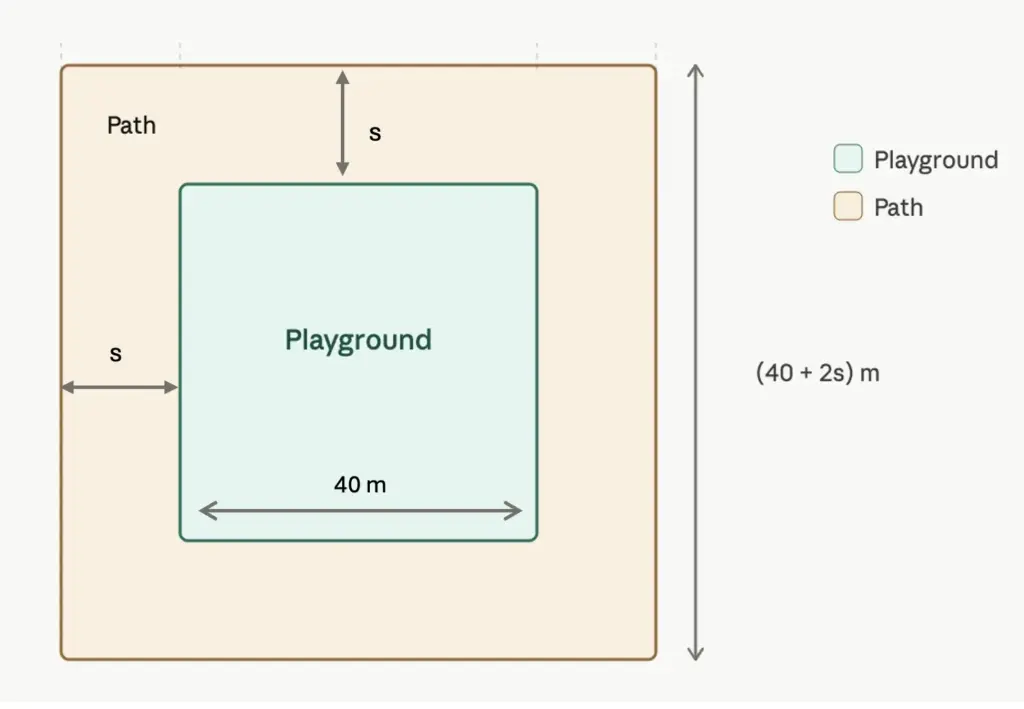
Side of the playground = 40 m
Width of the path = s m
Side of outer square = (40 + 2s) m
Area of the outer square = (40 + 2s)2 m2
Area of the square = (40)2 m2
Area of path = Outer area – Inner area
= (40 + 2s)2 – (40)2
Using (a + b)2 = a2 + 2ab + b2
= (40)2 + 2(40)(2s) + (2s)2 – (40)2
= 1600 + 160s + 4s2 – 1600
= 160s + 4s2
Hence, the required expression for the area of the path is (4s2 + 160s) m2.
If a number plus its reciprocal equals 103, find the number.
Let the number be x. Then,
x + 1x = 103
x2 + 1x = 103
By cross multiplication,
3(x2 + 1) = 10x
3x2 + 3 = 10x
3x2 – 10x + 3 = 0
3x2 – 9x – x + 3 = 0
3x(x – 3) −1(x – 3) = 0
(x – 3)(3x – 1) = 0
x = 3 and x = 13
Hence, the numbers are 3 and 13.
A rectangular pool has area 2x2 + 7x + 3 square hastas. If its width is 2x + 1 hastas, find its length. Hasta was a unit used to measure length.
Area of the pool = 2x2 + 7x + 3
Width of the pool = 2x + 1
Length = AreaBreadth = 2x2 + 7x + 32x + 1
Factorising the numerator:
2x2 + 7x + 3
= 2x2 + 6x + x + 3
= 2x(x + 3) + 1(x + 3)
= (x + 3)(2x + 1)
Therefore,
Length = (x + 3)(2x + 1)(2x + 1) = (x + 3)
Hence, the length of the rectangular pool is (x + 3) hastas.
If both x – 2 and x – 12 are factors of px2 + 5x + r, show that p = r.
If a + b + c = 5 and ab + bc + ca = 10, then prove that a3 + b3 + c3 −3abc = – 25.
Using the identity,
a3 + b3 + c3 – 3abc = (a + b + c)(a2 + b2 + c2 – ab – bc – ca)
a3 + b3 + c3 – 3abc = (a + b + c)(a2 + b2 + c2 + 2ab + 2bc + 2ac – 3ab – 3bc – 3ca)
a3 + b3 + c3 – 3abc = (a + b + c)[(a + b + c)2 – 3(ab + bc + ca)]
On substituting a + b + c = 5 and ab + bc + ca = 10,
a3 + b3 + c3 – 3abc = (5)[(5)2 – 3(10)]
a3 + b3 + c3 – 3abc = (5)(25 – 30)
a3 + b3 + c3 – 3abc = (5)(– 5)
a3 + b3 + c3 – 3abc = (–25)
Hence, proved.
By factoring the expression, check that n3 – n is always divisible by 6 for all natural numbers n. Give reasons.
n3 – n = n(n2 – 1)
= n × [(n)2 – (1)2]
Using a2 – b2 = (a – b)(a + b)
= n × (n – 1) × (n + 1)
Thus, n3 – n = n(n – 1)(n + 1)
This is the product of three consecutive natural numbers.
Among any three consecutive natural numbers:
• one number is always divisible by 3,
• at least one number is always even, i.e., divisible by 2.
Therefore, the product n(n − 1)(n + 1) is divisible by both 2 and 3.
Hence, it is divisible by 2 × 3 = 6.
Therefore, n3 − n is always divisible by 6 for all natural numbers n.
Find the value of
(i) x3 + y3 – 12xy + 64, when x + y = – 4
(ii) x3 – 8y3 – 36xy – 216, when x = 2y + 6
(i) Given that x + y = – 4
x + y + 4 = 0 …… (1)
x3 + y3 – 12xy + 64 = x3 + y3 + (4)3 – 3(x)(y)(4)
Using a3 + b3 + c3 – 3abc = (a + b + c)(a2 + b2 + c2 – ab – bc – ac)
x3 + y3 + 43 – 3(x)(y)(4) = (x + y + 4)[x2 + y2 + (4)2 – xy – (y)(4) – (x)(4)]
x3 + y3 – 12xy + 64 = (x + y + 4)(x2 + y2 + 16 – xy – 4y –4x)
x3 + y3 – 12xy + 64 = 0 × (x2 + y2 + 16 – xy – 4y –4x) …………. [Using (1)]
x3 + y3 – 12xy + 64 = 0
Hence, the value is 0.
(ii) Given that x = 2y + 6
x – 2y – 6 = 0 ……… (1)
x3 – 8y3 – 36xy – 216 = x3 + (–2y)3 + (–6)3 – 3(x)(–2y)(–6)
Using a3 + b3 + c3 – 3abc = (a + b + c)(a2 + b2 + c2 – ab – bc – ac)
x3 + (–2y)3 + (–6)3 – 3(x)(–2y)(–6) = [x + (–2y) + (–6)][x2 + (–2y)2 + (–6)2 – (x)(–2y) – (–2y)(–6) –(x)(–6)]
x3 – 8y3 – 36xy – 216 = (x – 2y – 6)(x2 + 4y2 + 36 + 2xy – 12y + 6x)
x3 – 8y3 – 36xy – 216 = 0 × (x2 + 4y2 + 36 + 2xy – 12y + 6x) …………. [Using (1)]
x3 – 8y3 – 36xy – 216 = 0
Hence, the value is 0.
Chapter 4 – Quick Revision
- (a + b)2 = a2 + 2ab + b2 and (a – b)2 = a2 – 2ab + b2.
- (a + b)(a – b) = a2 – b2.
- (a + b + c)2 = a2 + b2 + c2 + 2ab + 2bc + 2ca.
- (x + a)(x + b) = x2 + (a + b)x + ab.
- (a ± b)3 = a3 ± 3a2b + 3ab2 ± b3.
- a3 ± b3 = (a ± b)(a2 ∓ ab + b2).
- a3 + b3 + c3 – 3abc = (a + b + c)(a2 + b2 + c2 – ab – bc – ca); if a + b + c = 0, then a3 + b3 + c3 = 3abc.
- Identities help simplify rational expressions by factorising the numerator and denominator, provided the denominator is not zero.