
The World of Numbers
Ganita Manjari Part 1 · Chapter 3 · NCERT Solutions
Welcome to Encyclohub's complete NCERT solutions for Class 9 Maths – Chapter 3: The World of Numbers (Ganita Manjari Part 1).
All questions and solutions are presented clearly so you can understand every concept step by step. These solutions are useful for homework, revision and exam preparation.
Study Tip:
For decimal expansion questions, try performing the long division yourself before checking the solution.
Exercise Set 3.1
A merchant in the port city of Lothal is exchanging bags of spices for copper ingots. He receives 15 ingots for every 2 bags of spices. If he brings 12 bags of spices to the market, how many copper ingots will he leave with?
For 2 bags of spices, the merchant gets = 15 copper ingots.
For 1 bag of spices, the merchant gets = 152 ingots
Thus, for 12 bags, the number of ingots = 12 × 152 = 6 × 15 = 90.
Therefore, the merchant will leave with 90 copper ingots.
Look at the sequence of numbers on one column of the Ishango bone: 11, 13, 17, 19. What do these numbers have in common? List the next three numbers that fit this pattern.
The numbers 11, 13, 17, and 19 are prime numbers (each number is divisible only by 1 and itself).
The next three numbers in this pattern after 19 are 23, 29, 31.
We know that Natural Numbers are closed under addition (the sum of any two natural numbers is always a natural number). Are they closed under subtraction? Provide a couple of examples to justify your answer.
Natural numbers are not closed under subtraction.
Justification:
5 − 3 = 2, which is a natural number.
3 − 5 = −2, which is not a natural number.
Since the subtraction of two natural numbers does not always result in a natural number, natural numbers are not closed under subtraction.
Ancient Indians used the joints of their fingers to count, a practice still seen today. Each finger has 3 joints, and the thumb is used to count them. How many can you count on one hand? How does this relate to the ancient base-12 counting systems?
Each hand has 4 fingers (excluding the thumb), and each finger has 3 joints.
So, total joints = 4 × 3 = 12.
We can count up to 12 on one hand.
Since counting on one hand gives 12, this method naturally leads to counting in groups of 12. Hence, it is related to the base-12 system used in ancient times.
Exercise Set 3.2
The temperature in the high-altitude desert of Ladakh is recorded as 4 °C at noon. By midnight, it drops by 15 °C. What is the midnight temperature?
Temperature at noon = 4°C
Drop in temperature = 15°C
So, Midnight temperature = 4 − 15 = −11°C
Therefore, the temperature at midnight is −11°C.
A spice trader takes a loan (debt) of ₹850. The next day, he makes a profit (fortune) of ₹1,200. The following week, he incurs a loss of ₹450. Write this sequence as an equation using integers and calculate his final financial standing.
Loan (debt) = −850
Profit = +1200
Loss = −450
So, the equation is: −850 + 1200 − 450
Now calculate:
−850 + 1200 – 450 = 350 – 450 = −100
Therefore, his final financial standing is ₹–100, which means he is still in debt of ₹100.
Calculate the following using Brahmagupta's laws:
(i) (–12) × 5
(ii) (–8) × (–7)
(iii) 0 – (–14)
(iv) (–20) ÷ 4
(i) (–12) × 5
Negative × Positive = Negative
(–12) × 5 = –60
(ii) (–8) × (–7)
Negative × Negative = Positive
(–8) × (–7) = 56
(iii) 0 – (–14)
Subtracting a negative = Adding a positive
0 + 14 = 14
(iv) (–20) ÷ 4
Negative ÷ Positive = Negative
(–20) ÷ 4 = –5
Explain, using a real-world example of debt, why subtracting a negative number is the same as adding a positive number (e.g., 10 – (–5) = 15).
Positive numbers represent your fortune, and negative numbers represent debt.
Suppose you have ₹10. Subtracting −₹5 means removing a debt of ₹5.
So, 10 − (−5) = 10 + 5 = 15
Explanation: Removing a debt increases your fortune. Therefore, subtracting a negative number is the same as adding a positive number.
Exercise Set 3.3
Prove that the following rational numbers are equal:
(i) 23 and 46 (ii) 54 and 108 (iii) -35 and -610 (iv) 93 and 3
(i) 23 and 46
So, 23=46
(ii) 54 and 108
So, 54=108
(iii) -35 and -610
So, -35=-610
(iv) 93 and 3
So, 93=3
Find the sum:
(i) 25+310 (ii) 712+58 (iii) -47+314
(i) 25+310
LCM of 5 and 10 = 10
(ii) 712+58
LCM of 12 and 8 = 24
(iii) -47+314
LCM of 7 and 14 = 14
Find the difference:
(i) 56-14 (ii) 118-34 (iii) -79-(-23)
(i) 56-14
LCM of 6 and 4 = 12
(ii) 118-34
LCM of 8 and 4 = 8
(iii) -79-(-23)
LCM of 9 and 3 = 9
Find the product:
(i) 23×310 (ii) 711×58 (iii) -47×514
(i) 23×310=2×33×10
Cancelling 3,
(ii) 711×58=7×511×8=3588
(iii) -47×514=-4×57×14=-2098=-1049
Find the quotient:
(i) 23÷310 (ii) 711÷58 (iii) -47÷514
(i) 23÷310=23×103=209=229
(ii) 711÷58=711×85=5655=1155
(iii) -47÷514=-47×145=-5635=-85=-135
Show that: (12+34)×83=12×83+34×83.
LHS =(12+34)×83
LCM of 2 and 4 = 4
RHS =12×83+34×83
Hence, verified LHS = RHS.
Simplify the following using the distributive property: 79(67-34)
67-34
LCM of 7 and 4 = 28
Thus 79(67-34)=79×328=21252=112.
Find the rational number x such that: 56(x+35)=56x+12
LHS =56(x+35)=56x+56×35=56x+12
RHS =56x+12
Hence, LHS = RHS. This is an identity true for all values of x.
Exercise Set 3.4
Represent the rational numbers 23, -54 and 112 on a single number line.
(i) 23

(ii) -54

(iii) 112=32

Find three distinct rational numbers that lie strictly between -12 and 14.
Converting the given numbers to a common denominator.
So, the rational numbers between -48 and 28 are -34, -24, -14.
Simplify the expression: (-14)+(512).
(-14)+(512)
LCM of 4 and 12 = 12
So, (-14)+(512)=-312+512=-3+512=212=16.
A tailor has 1534 metres of fine silk. If making one kurta requires 214 metres of silk, exactly how many kurtas can he make?
Total silk = 1534 m = 634 m
Silk needed for 1 kurta = 214 m = 94 m
Therefore, he can make exactly 7 kurtas.
Find three rational numbers between 3.1415 and 3.1416.
Writing the numbers with more decimal places:
3.1415 = 3.14150
3.1416 = 3.14160
Choose any numbers between them: 3.14151, 3.14152, 3.14153.
Therefore, three rational numbers are 3.14151, 3.14152, 3.14153.
Can you think of other way(s) to find a rational number between any two rational numbers?
Yes, there are other ways.
Method 1: If a and b are two rational numbers, then a+b2 is a rational number lying between them.
Method 2: Once we find one number between a and b, we can again find the mean between the new numbers to get more rational numbers. In this way, infinitely many rational numbers can be found between any two rational numbers.
Exercise Set 3.5
Without performing long division, determine which of the following rational numbers will have terminating decimals and which will be repeating: 720, 415 and 13250. Then check your answers by explicitly performing the long divisions and expressing these rational numbers as decimals.
A rational number p/q (in lowest terms) has a terminating decimal if and only if the denominator q has no prime factors other than 2 and 5.
(i) 720
20 = 2² × 5
Since the denominator has only the prime factors 2 and 5, the decimal expansion is terminating.
Verification:
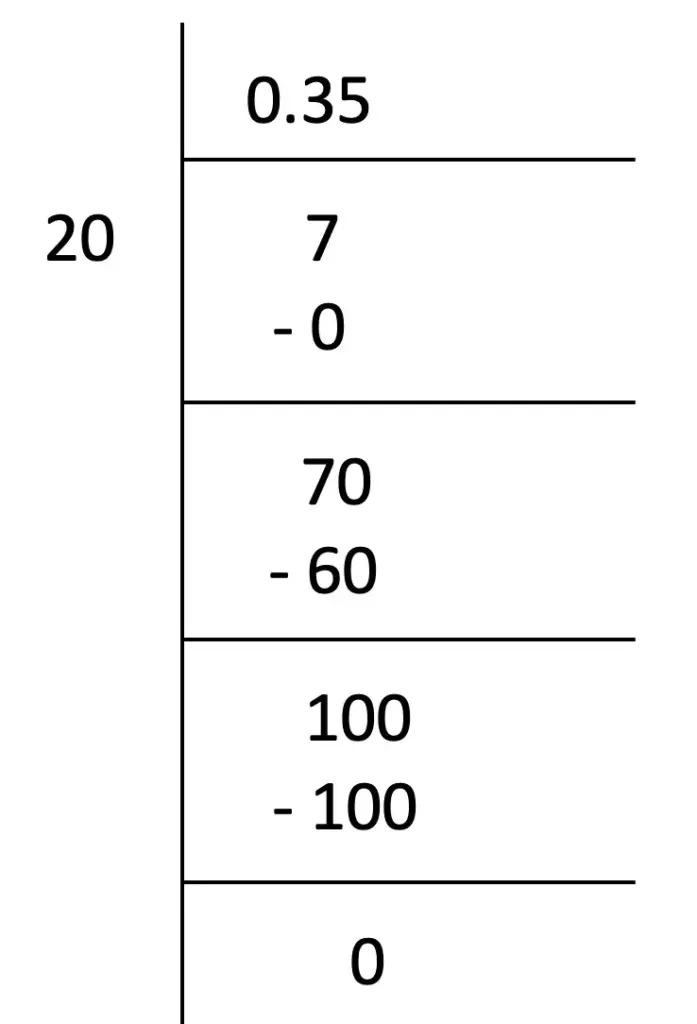
720 = 0.35
Hence, the given rational number is a terminating decimal.
(ii) 415
15 = 3 × 5
Since the denominator has a prime factor 3 (other than 2 or 5), the decimal expansion is non-terminating repeating.
Verification:
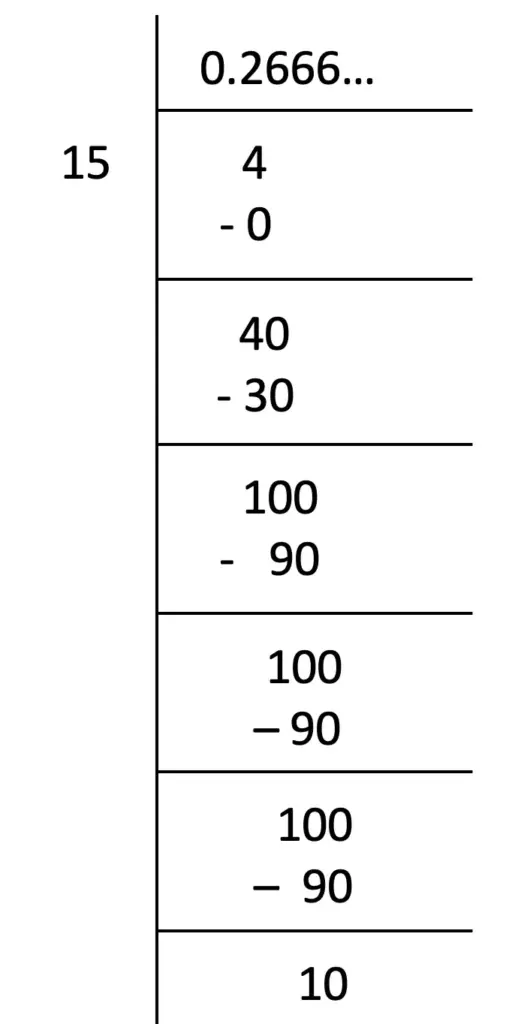
415 = 0.2666… = 0.26
Hence, the given rational number is a repeating decimal.
(iii) 13250
250 = 2 × 5³
Since the denominator has only the prime factors 2 and 5, the decimal expansion is terminating.
Verification:
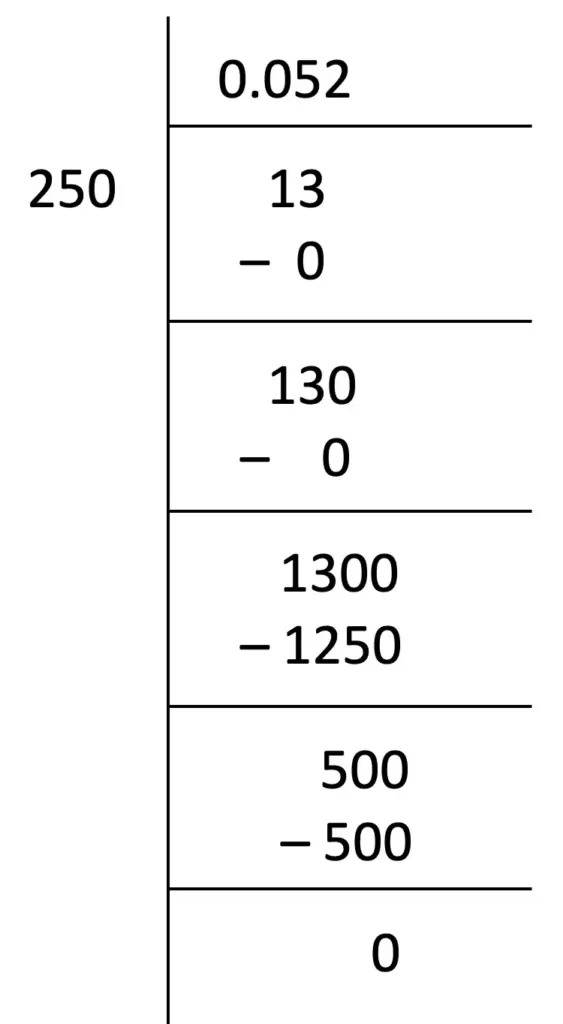
13250 = 0.052
Hence, the given rational number is a terminating decimal.
Perform the long division for 113. Identify the repeating block of digits. Does it show cyclic properties if you evaluate 213? Now compute 313, 413, etc. What do you notice?
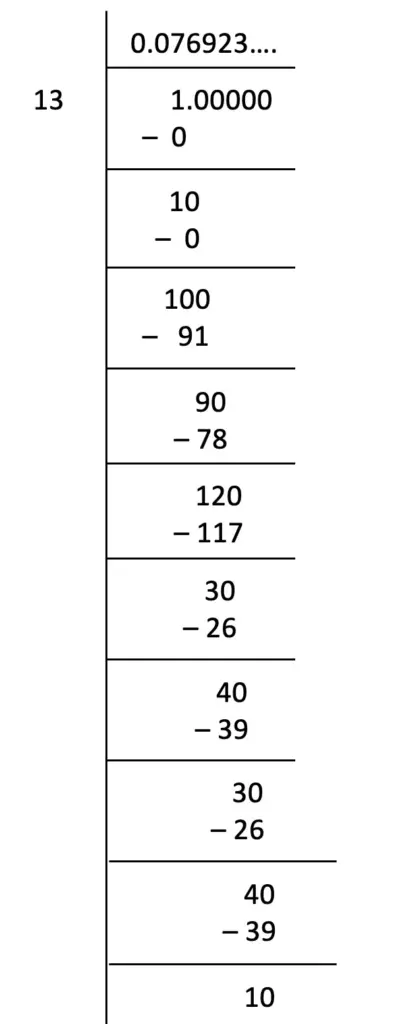
113 = 0.076923
Repeating block: 076923 (6 digits)
Now,
213 = 0.153846
313 = 0.230769
413 = 0.307692
513 = 0.384615
613 = 0.461538
Observations: These decimal expansions show a cyclic property. The repeating digits are the same (0, 7, 6, 9, 2, 3) but appear in a different order in each case.
Classify the following numbers as rational or irrational:
(i) √81 (ii) √12 (iii) 0.33333 … (iv) 0.123451234512345 … (v) 1.01001000100001 … (Notice the pattern: Is it repeating a single block?)
(i) √81=√92=9
Since 9 is rational number.
∴ √81 is rational.
(ii) √12=√3×4=√3×22=2√3
Since √3 is irrational, 2√3 is also irrational.
∴ √12 is irrational.
(iii) 0.33333 …
This is a non-terminating repeating decimal.
∴ it is rational.
(iv) 0.123451234512345 … = 0.12345
This is a non-terminating repeating decimal.
∴ it is rational.
(v) 1.01001000100001 …
This is a non-terminating, non-repeating decimal.
∴ 1.01001000100001… is an irrational number.
The number 0.9 (which means 0.99999 … ) is a rational number. Using algebra (let x = 0.9, multiply by 10, and subtract), explain why 0.9 is exactly equal to 1.
Let x = 0.9999… ……… (1)
Multiply both sides by 10:
10x = 9.9999… ……… (2)
Now subtract equation (1) from equation (2):
10x − x = 9.9999… – 0.9999…
9x = 9
x = 1
Since x = 0.9999…, we get: 0.9999… = 1
We have seen that the repeating block of 17 is a cyclic number. Try to find more numbers (n) whose reciprocals (1n) produce decimals with repeating blocks that are cyclic.
We know that 17=0.142857
It has a repeating block whose digits appear in cyclic order.
Similarly, we find other values of n such that 1n gives a cyclic repeating decimal.
113=0.076923
117=0.0588235294117647
119=0.0526315789417368421
123=0.0434782608695652173913
In each case, the digits in the repeating block are the same, and the decimal expansions of 2n, 3n, … are obtained by cyclic shifts of these digits.
End of Chapter Exercises
Convert the following rational numbers in the form of a terminating decimal or non-terminating and repeating decimal, whichever the case may be, by the process of long division:
(i) 350 (ii) 29
(i) 350
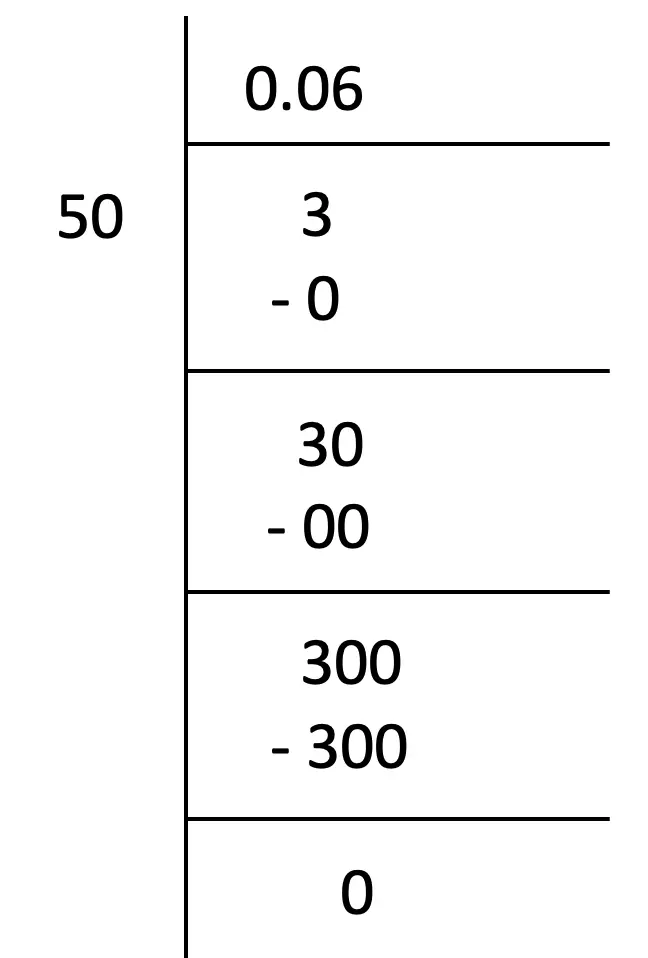
350 = 0.06
This is a terminating decimal.
(ii) 29
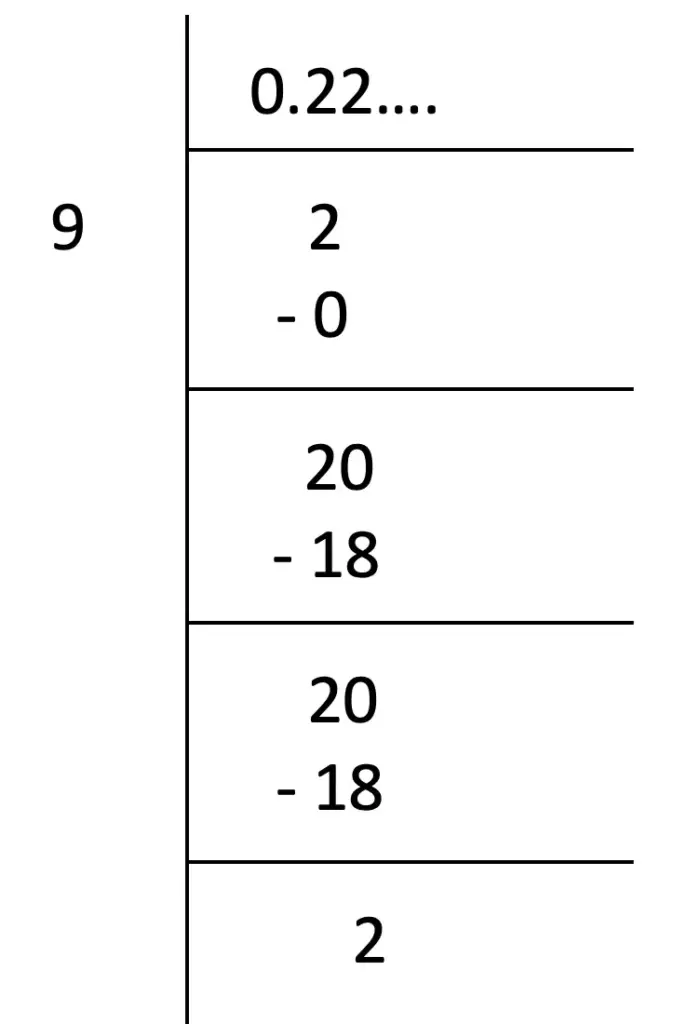
29 = 0.2222….
This is a non-terminating and repeating decimal.
Prove that √5 is an irrational number.
Assume that √5 is rational.
Then it can be written in the form √5=ab where a and b are integers having no common factor other than 1.
Squaring both sides:
5 = a2b2
5b² = a²
This shows that a² is divisible by 5, so a is divisible by 5.
Let a = 5k, where k is an integer.
Substituting:
5b² = (5k)²
5b² = 25k²
b² = 5k²
This shows that b² is divisible by 5, so b is also divisible by 5.
Thus, both a and b are divisible by 5, which contradicts the fact that a and b have no common factor other than 1.
Therefore, our assumption is wrong. √5 is irrational.
Convert the following decimal numbers in the form of pq.
(i) 12.6 (ii) 0.0120 (iii) 3.052 (iv) 1.235 (v) 0.23 (vi) 2.05 (vii) 2.125 (viii) 3.125 (ix) 2.1625
(i) 12.6
12.6 = 12610=635
(ii) 0.0120
0.0120 = 12010000=3250
(iii) 3.052
Let x = 3.052 ……… (1)
Multiply both sides by 100:
100x = 305.252 ……… (2)
Now subtract equation (1) from equation (2):
100x − x = 305.252 – 3.052
99x = 302.2
99x = 302210
x = 3022990=1511495
(iv) 1.235
Let x = 1.235 ……… (1)
Multiply both sides by 100:
100x = 123.535 ……… (2)
Now subtract equation (1) from equation (2):
100x − x = 123.535 – 1.235
99x = 122.3
99x = 122310
x = 1223990
(v) 0.23
Let x = 0.23 ……… (1)
Multiply both sides by 100:
100x = 23.23 ……… (2)
Now subtract equation (1) from equation (2):
100x − x = 23.23 – 0.23
99x = 23
x = 2399
(vi) 2.05
Let x = 2.05 ……… (1)
Multiply both sides by 10:
10x = 20.55 ……… (2)
Now subtract equation (1) from equation (2):
10x − x = 20.55 – 2.05
9x = 18.5
9x = 18510
x = 18590=3718
(vii) 2.125
Let x = 2.125 ……… (1)
Multiply both sides by 10:
10x = 21.255 ……… (2)
Now subtract equation (1) from equation (2):
10x − x = 21.255 – 2.125
9x = 19.13
9x = 1913100
x = 1913900
(viii) 3.125
Let x = 3.125 ……… (1)
Multiply both sides by 10:
10x = 31.255 ……… (2)
Now subtract equation (1) from equation (2):
10x − x = 31.255 – 3.125
9x = 28.13
9x = 2813100
x = 2813900
(ix) 2.1625
Let x = 2.1625 ……… (1)
Multiply both sides by 10000:
10000x = 21625.1625 ……… (2)
Now subtract equation (1) from equation (2):
10000x – x = 21625.1625 – 2.1625
9999x = 21623
x = 216239999
Locate the following rational numbers on the number line.
(i) 0.532 (ii) 1.15
(i) 0.532
Here, 0.532 = 5321000
To locate on the number line:
Divide the segment from 0 to 1 into 10 equal parts. Each part represents 0.1.
Take the point 0.5.
Now divide the segment from 0.5 to 0.6 into 10 equal parts. Each part represents 0.01.
Take the point 0.53.
Now divide the segment from 0.53 to 0.54 into 10 equal parts. Each part represents 0.001.
Take the second division after 0.53.
So, we get the point 0.532 on the number line.

(ii) 1.15
Let x = 1.15 ……… (1)
Multiply both sides by 10:
10x = 11.55 ……… (2)
Now subtract equation (1) from equation (2):
10x − x = 11.55 – 1.15
9x = 10.4
9x = 10410
x = 10490=5245
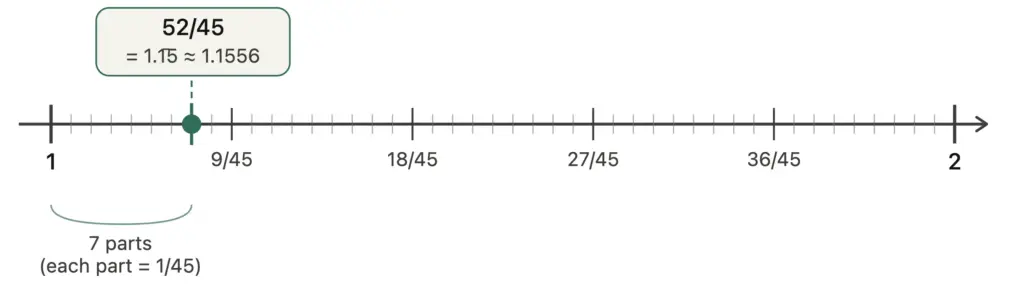
To locate on the number line:
5245=45+745=1+745
So it lies between 1 and 2.
Divide the segment from 1 to 2 into 45 equal parts.
Mark the point 7th division to the right of 1.
This point represents 1.15 on the number line.
Find 6 rational numbers between 3 and 4.
Multiply the numerator and denominator by 7,
3 = 3×71×7=217, 4 = 4×71×7=287
Now six rational numbers between 217 and 287: 227, 237, 247, 257, 267, 277.
So, six rational numbers between 3 and 4 are 227, 237, 247, 257, 267, 277.
Find 5 rational numbers between 25 and 35.
Convert both fractions to a common denominator:
25=2×75×7=1435 and 35=3×75×7=2135
Now pick five numbers between 1435 and 2135: 1535, 1635, 1735, 1835, 1935
So, five rational numbers between 25 and 35 are 1535, 1635, 1735, 1835, 1935.
Find 5 rational numbers between 16 and 25.
Convert both fractions to a common denominator:
16=1×56×5=530 and 25=2×65×6=1230
Now pick five numbers between 530 and 1230: 630, 730, 830, 930, 1030
So, five rational numbers between 16 and 25 are 630, 730, 830, 930, 1030.
If x3+x5=1615, find the rational number x.
x3+x5=1615
LCM of 3 and 5 = 15
x = 16×1515×8
x = 2.
Let a and b be two non-zero rational numbers such that a +1b = 0. Without assigning any numerical values, determine whether ab is positive or negative. Justify your answer.
a +1b = 0
a = -1b
ab = a·b = -1b· b = –1
ab = –1
So, ab is negative.
A rational number has a terminating decimal expansion whose last non-zero digit occurs in the 4th decimal place. Show that such a number can be written in the form p104, where p is an integer not divisible by 10. Is it necessary that the denominator of this rational number, when written in the lowest form, is divisible by 2⁴ or 5⁴? Give reasons.
Let the rational number be x. Since its decimal expansion terminates and the last non-zero digit is at the 4th decimal place, we can write
x = 0.a₁a₂a₃a₄, where a₄ ≠ 0
Multiplying by 10⁴, we get
10⁴x = a₁a₂a₃a₄ = p (an integer)
x = a1a2a3a4104
Since a₄ ≠ 0, p is not divisible by 10.
Now, 10⁴ = (2 × 5)⁴ = 2⁴ × 5⁴
When p104 is written in lowest terms, common factors of 2 and/or 5 may cancel.
Therefore, it is necessary that the denominator in the lowest form is divisible by 2⁴ or 5⁴.
Without performing division, determine whether the decimal expansion of 18125 is terminating or non-terminating. If it terminates, state the number of decimal places.
Prime factorisation of the denominator:
125 = 5 × 5 × 5 = 5³
Since the denominator has only the prime factor 5, the decimal expansion is terminating.
Further, 18125=18×8125×8=1441000
So, the decimal expansion terminates and has 3 decimal places.
A rational number in its lowest form has a denominator 2³ × 5. How many decimal places will its decimal expansion have? Explain your answer.
Given denominator = 2³ × 5 = 8 × 5 = 40.
Since the denominator has the prime factors 2 and 5, the decimal expansion is terminating.
To find the number of decimal places, make the denominator a power of 10.
So multiply by 5²:
2³ × 5 × 5² = 2³ × 5³ = 10³
Thus, the denominator becomes 10³.
Hence, the decimal expansion will terminate and have 3 decimal places.
Let a = 712 and b = 56. Express both a and b in the form k1m and k2m where k₁, k₂ and m are integers and k₂ – k₁ > 6. Using the same denominator m, write exactly five distinct rational numbers lying between a and b, keeping an integer numerator. Explain why the condition k₂ – k₁ > n + 1 is necessary to find n such rational numbers between the two rational numbers a and b using this method.
Given, a = 712 and b = 56
Convert to a common denominator:
a = 712=7×212×2=1424, b = 56=5×46×4=2024
Here k₁ = 14, k₂ = 20, m = 24
k₂ – k₁ = 20 – 14 = 6
So we need a larger common denominator. Scaling up to m = 48
a = 712=1424=14×224×2=2848, b = 56=2024=20×224×2=4048
Now k₁ = 28, k₂ = 40, m = 48
k₂ – k₁ = 40 – 28 = 12 > 6
Numbers between 28 and 40 are 29, 30, 31, 32, 33.
So, the required rational numbers are 2948, 3048, 3148, 3248, 3348.
Explanation: With a shared denominator, the only candidates are fractions with integer numerators strictly between k₁ and k₂. There are exactly k₂ – k₁ – 1 such integers. To fit at least n of them:
Three rational numbers x, y, z satisfy x + y + z = 0 and xy + yz + zx = 0. Show that all the rational numbers x, y, z must be simultaneously zero.
Given that
x + y + z = 0 ……… (1)
xy + yz + zx = 0 ……… (2)
Squaring equation (1),
(x + y + z)² = 0
x² + y² + z² + 2(xy + yz + zx) = 0
Using equation (2)
x² + y² + z² + 2(0) = 0
x² + y² + z² = 0
Since x, y, z are rational numbers, each of x², y², z² is non-negative.
A sum of non-negative terms equals zero if and only if every term is zero:
x² = 0, y² = 0, z² = 0
∴ x = 0, y = 0, z = 0
Show that the rational number (a+b)2 lies between the rational numbers a and b.
Let us assume a < b.
Since a < b, adding a to both sides:
a + a < a + b
2a < (a + b)
a < (a+b)2
Again, since a < b, adding b to both sides:
a + b < b + b
(a + b) < 2b
(a+b)2 < b
Therefore, a < (a+b)2 < b
Hence, (a+b)2 lies between a and b.
Find the lengths of the hypotenuses of all the right triangles in Fig. 3.14 which is referred to as the square root spiral.
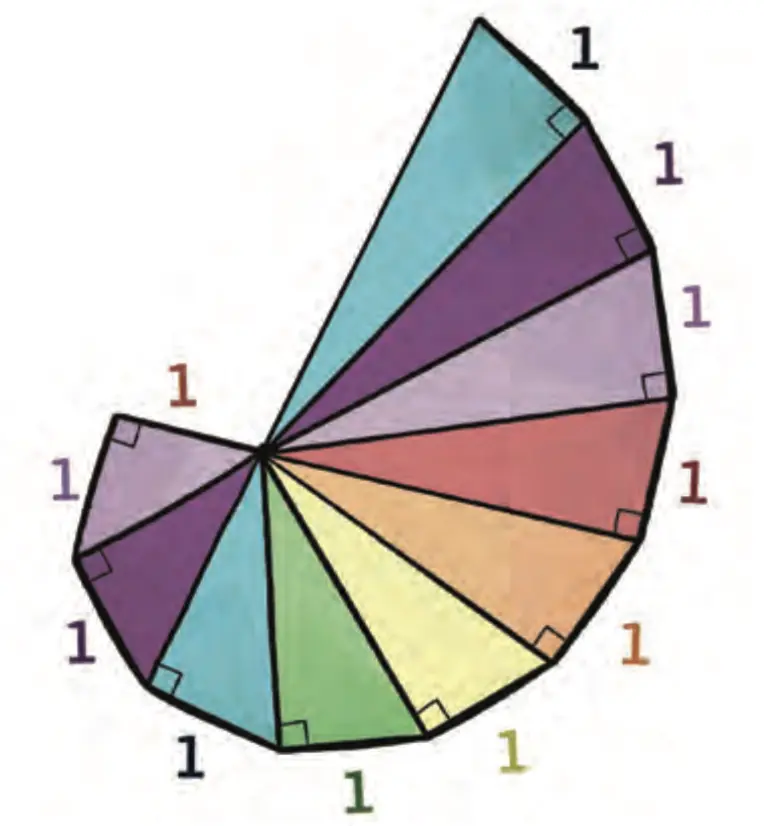
This is the square root spiral. Each triangle in the spiral is formed by taking one given leg and the previous hypotenuse as the other leg.
1st triangle: Hypotenuse = √12+02 = 1
2nd triangle: Hypotenuse = √12+12=√2
3rd triangle: Hypotenuse = √(√2)2+12=√3
4th triangle: Hypotenuse = √(√3)2+12=√3+1=2=√4
Continuing this pattern, each time: New hypotenuse = √n
Therefore, the hypotenuses are: √1, √2, √3, √4, √5, √6, √7, √8, √9, …
Chapter 3 – Quick Revision
- Natural numbers are closed under addition and multiplication, but not under subtraction and division.
- Integers extend natural numbers to include negative numbers and zero.
- A rational number can be written in the form p/q, where q ≠ 0.
- Between any two rational numbers, infinitely many rational numbers exist.
- A rational number has either a terminating or a non-terminating repeating decimal expansion.
- The decimal expansion of p/q (in lowest terms) is terminating only if q has no prime factors other than 2 and 5.
- Numbers whose decimal expansion is non-terminating and non-repeating are irrational numbers.