1. Introduction and Examination Schedule
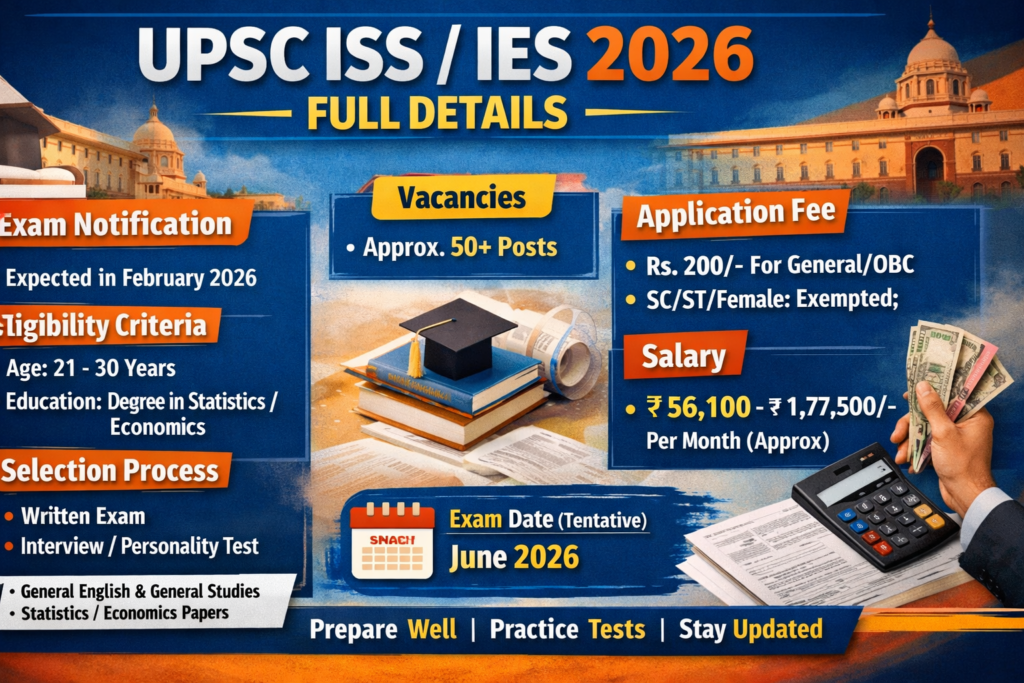
The Union Public Service Commission has issued Examination Notice No. 07/2026-IES/ISS, dated February 11, 2026. This combined competitive examination is conducted for recruitment to the Junior Time Scale of the Indian Economic Service and the Indian Statistical Service.
Key Dates to Remember:
- Notification Release: February 11, 2026.
- Last Date for Application: March 3, 2026, until 6:00 PM (18:00 hours).
- Examination Commencement: June 19, 2026.
The examination will be held in accordance with the rules published by the Ministry of Statistics & Programme Implementation in the Gazette of India.
2. Vacancy Details and Reservations
The recruitment for the year 2026 seeks to fill a total of 44 tentative vacancies across two primary services:
- Indian Economic Service (IES): 16 vacancies.
- Indian Statistical Service (ISS): 28 vacancies.
Reservation Policies:
- Reservations are provided for candidates belonging to Scheduled Castes (SC), Scheduled Tribes (ST), Other Backward Classes (OBC), Economically Weaker Sections (EWS), and Persons with Benchmark Disability (PwBD) as fixed by the Government.
- Specific PwBD Reservations:
- IES: One vacancy is reserved for category ‘e’ (multiple disabilities from categories a to c), provided the post is not earmarked for a combination of complete blindness and complete deafness.
- ISS: Two vacancies are reserved. One is a carried-forward vacancy for Deaf and Hard of Hearing (D/HH), and one fresh vacancy is for Special Learning Disability/Multiple Disability (SLD/MD).
- Category Changes: Candidates cannot change their category from Unreserved to Reserved or between reserved categories (e.g., SC to ST) once the application is submitted.
3. Eligibility Conditions
To apply, candidates must meet specific criteria regarding nationality, age, and education.
A. Nationality
A candidate must be:
- A citizen of India, or
- A subject of Nepal or Bhutan, or
- A Tibetan refugee who came to India before January 1, 1962, to settle permanently, or
- A person of Indian origin migrated from Pakistan, Burma, Sri Lanka, or specific East African countries/Vietnam with the intention of settling permanently. Note: Candidates in categories 2, 3, and 4 must possess a certificate of eligibility issued by the Government of India.
B. Age Limits
Candidates must have attained 21 years and must not have reached 30 years of age on August 1, 2026. This means they must have been born between August 2, 1996, and August 1, 2005.
Upper Age Relaxations:
- SC/ST: Up to 5 years.
- OBC: Up to 3 years.
- Defence Services Personnel (disabled in operations): Up to 3 years.
- Ex-servicemen (including Commissioned Officers/ECOs/SSCOs with 5 years service): Up to 5 years.
- PwBD: Up to 10 years.
- Cumulative Relaxation: Candidates belonging to SC/ST or OBC who also fall under the Ex-servicemen or PwBD categories are eligible for cumulative age relaxation.
C. Minimum Educational Qualifications
- For IES: A Post-Graduate Degree in Economics, Applied Economics, Business Economics, or Econometrics from a recognized university.
- For ISS: A Bachelor’s Degree with Statistics, Mathematical Statistics, or Applied Statistics as a subject studied in all years of the course, or a Master’s Degree in these subjects.
- Appearing Candidates: Those who have appeared at the qualifying exam but have not received results are eligible to apply, but they must provide proof of passing if they qualify for the Interview/Personality Test.
4. Detailed Application Procedure
The Commission mandates that all applications must be submitted online only via https://upsconline.nic.in.
A. The Four-Module Portal
The online registration process is divided into four distinct modules:
- Account Creation: For basic user access.
- Universal Registration: Generation of a Universal Registration Number (URN), which is unique and remains constant for life for all UPSC exams.
- Common Application Form (CAF): General data common to all exams.
- Examination Specific Module: Specific to IES/ISS, including fee payment and centre selection.
B. Photo and Signature Requirements
- Live Photo Capture: Applicants must upload a photograph and also capture a live photograph during the CAF process.
- Signature: Applicants must sign three times (one below the other) on plain white paper with black ink and upload the scanned image.
- File Sizes: Scanned photos must be between 20 KB and 200 KB; signatures must be between 20 KB and 100 KB.
C. Identification
Candidates must provide details of a Photo ID Card (Aadhaar, Voter Card, PAN, Passport, etc.). The Commission strongly advises using the Aadhaar Card for “easy, effortless and seamless verification”.
D. Application Fee
- Amount: Rs. 200.
- Exemptions: All Female candidates, SC, ST, and PwBD candidates are exempted from paying the fee.
- Payment Modes: Net Banking, Visa/Master/RuPay/Credit/Debit Card, or UPI.
- No Refunds: Fees once paid are not refundable or transferable to other exams.
5. Examination Centres and Allotment
The examination will be conducted at 21 centres across India:
- Ahmedabad, 2. Bengaluru, 3. Bhopal, 4. Chandigarh, 5. Chennai, 6. Cuttack, 7. Delhi, 8. Dispur, 9. Faridabad, 10. Ghaziabad, 11. Hyderabad, 12. Jaipur, 13. Jammu, 14. Kolkata, 15. Lucknow, 16. Mumbai, 17. Patna, 18. Prayagraj (Allahabad), 19. Shillong, 20. Shimla, 21. Thiruvananthapuram.
The “First-Apply-First-Allot” Principle: UPSC applies a ceiling on the number of candidates for each centre except for Ahmedabad, Chennai, Delhi, Dispur, and Kolkata. Allotment is strictly on a “first-apply-first-allot” basis. Once a centre’s capacity is reached, it will be frozen for non-PwBD candidates.
6. Scheme of the Examination
The examination consists of two main parts: a written test and a viva voce.
Part I: Written Examination (1000 Marks)
A. Indian Economic Service (IES) Subjects:
- General English: 100 Marks (3 hours)
- General Studies: 100 Marks (3 hours)
- General Economics-I: 200 Marks (3 hours)
- General Economics-II: 200 Marks (3 hours)
- General Economics-III: 200 Marks (3 hours)
- Indian Economics: 200 Marks (3 hours)
B. Indian Statistical Service (ISS) Subjects:
- General English: 100 Marks (3 hours)
- General Studies: 100 Marks (3 hours)
- Statistics-I (Objective): 200 Marks (2 hours, 80 questions)
- Statistics-II (Objective): 200 Marks (2 hours, 80 questions)
- Statistics-III (Descriptive): 200 Marks (3 hours)
- Statistics-IV (Descriptive): 200 Marks (3 hours)
Paper Types:
- General English and General Studies (common to both services) are subjective/conventional.
- All IES Economics papers are subjective.
- ISS Statistics III and IV are descriptive, featuring a mix of short answer/small problems (50%) and long answer/comprehension problems (50%).
Part II: Viva Voce (200 Marks)
Qualified written exam candidates are called for an interview. The goal is to assess suitability for the service, intellectual curiosity, critical powers of assimilation, balance of judgment, alertness of mind, social cohesion, integrity, and leadership capacity.
7. Rules and Penalties in the Examination
A. Negative Marking: In Objective Type papers, there is a penalty for wrong answers. Each incorrect response will result in a deduction of one-third (0.33) of the marks assigned to that question. If a candidate marks multiple answers, it is treated as a wrong answer.
B. OMR Sheet Instructions:
- Use black ball point pen only for marking and writing on OMR sheets.
- Mistakes in encoding the Roll Number or Test Booklet Series Code can result in the rejection of the answer sheet.
C. Banned Items: Mobile phones, pagers, smartwatches, Bluetooth devices, or any electronic/programmable devices are strictly prohibited inside the examination venue, even in switched-off mode.
D. Face Authentication: Candidates must undergo mandatory face authentication at the venue. Failure to arrive early for this process and frisking could result in denial of entry.
8. Specialized Provisions for PwBD Candidates
A. Scribe Facility:
- Candidates with blindness, locomotor disability (both arms affected), or cerebral palsy are eligible for a scribe.
- Other categories can request a scribe if they have a certified physical limitation to write.
- Candidates can bring their own scribe or request one from the Commission.
B. Compensatory Time: Eligible PwBD candidates are entitled to 20 minutes per hour of compensatory time.
9. Syllabus Overviews
- General English: Candidates write an essay and answer questions to test their workmanlike use of words and understanding of English (precis/summary).
- General Studies: Includes current events, everyday scientific observations, Indian Polity (Constitution), History of India, and Geography.
- General Economics I (IES): Covers Consumer Demand, Theory of Production, Value, Distribution, Welfare Economics, and Quantitative Methods (Mathematical/Statistical/Econometric).
- Statistics I (ISS): Covers Probability, Statistical Methods, Numerical Analysis, and Computer Application/Data Processing.
and full syllabus covered in offical notification
10. Post-Examination: Pratibha Setu Portal
Under the Pratibha Setu Portal (formerly the Public Disclosure Scheme), the Commission will share the details of candidates who reached the final stage (Interview) but were not recommended. This data is made accessible to registered Private Companies and Public Sector Undertakings to help these candidates find employment elsewhere. Candidates must give their consent for this during the application process.
11. Correspondence and Helpdesk
For any issues regarding the application process, fee payment, or document uploading, candidates can contact the UPSC Helpdesk:
- Phone: 011-24041001.
- Email: upscsoap@nic.in.
- Hours: 10:00 AM to 5:30 PM on all working days during the application window.
Candidates are reminded that applications cannot be withdrawn after submission. Therefore, it is essential to ensure all entries in the URN Profile and CAF are accurate before final submission.
Disclaimer: This response is based solely on the provided UPSC examination notification excerpts. Information regarding specific university approvals or updated government acts beyond the text is from my general training and should be independently verified if critical.